The New New Product Development Model 3.0: Precision Product Management in the Age of Agentic AI
With Product Model 3.0 every iteration is anchored in customer adoption and willingness-to-pay (WTP) sensing with Next Best Optimization (NBO) economics - making every move a "Product Investment with House Money." "Your goal shouldn't be to buy players. Your goal should be to buy wins. And in order to buy wins, you need to buy runs." - Peter Brand (played by Jonah Hill), Moneyball
In 1986, Hirotaka Takeuchi and Ikujiro Nonaka published "The New New Product Development Game" in the Harvard Business Review. In their analysis of companies that redefined their markets such as Cannon, Xerox, 3M and Honda, they introduced the rugby "scrum" approach to product development in cross functional teams, replacing the relay-race style "siloed, waterfall" process of the prior generation. This paper became a catalyst for Agile product innovation.
We are entering the 3.0 era. If the original "New New Game" 2.0 was about the speed of innovation-based teams, the Agentic Era is about the economic yield of the hyper-personalized AI Product Operating Model.
We are moving beyond Agile into Model-Optimized Product Management. This isn't just about building faster; it’s about using AI to collapse the distance between customer demand-side signals to shipping Minimum Viable Products (MVPs) and Minimum Marketable Features (MMFs) with next level product market fit.
With 3.0 every product iteration is anchored in customer adoption and willingness-to-pay (WTP) sensing with Next Best Optimization (NBO) economics - making every move a "Product Investment with House Money."
"Your goal shouldn't be to buy players. Your goal should be to buy wins. And in order to buy wins, you need to buy runs." - Peter Brand (played by Jonah Hill), Moneyball
The Supply-Side Trap: Why Agentic Development Isn’t Enough
We are currently witnessing an enterprise gold rush to "Supply-Side" efficiency. Agentic Development enables feature development at a velocity unimaginable just two years ago.
Speed without a model for managing investment risk is just higher-velocity waste. It is inefficient - and ultimately fatal - to point agentic development at an open-ended stream of product ideas.
Think of the "AI slop" when everyone started posting LLM-generated content from the same models.
When the cost of production drops to near zero, the bottleneck shifts to the Demand-Side Frontier.
We must ask:
- Can we really see the business as our customers do?
- Is it possible for a customer with a critical challenge and solution opportunity to reach someone with the decision authority to make the product better?
The "Holy Grail" of modern product management is not "shipping faster." It’s sensing Next Best Optimization (NBO) - the specific, targeted, small-batch innovations with a pre-validated adoption curve.
Closing the Gap with Next Best Optimization (NBO)
The core thesis of this new era is simple: Aggregate customer signals into a data defined hypothesis before defining solutions.
By leveraging AI to synthesize massive volumes of unstructured customer and frontline workforce signals - e.g., support cases, reviews, direct intelligence pulses with nVeris, you are building and maintaining a high-fidelity model of the customer product experience.
Customer Signal Aggregation: Aggregate 10,000 or 100,000 distinct signals into a coherent "Demand-Side Frontier" in minutes.
Willingness to Pay (WTP) Validation: Identify demand patterns on the "edge" and trigger alerts as they reach a threshold for investment.
Yield Management: Just as airlines use yield management to optimize seat pricing, or Amazon runs supply chain optimization to stage products for changing demand, NBO optimizes "development yield."
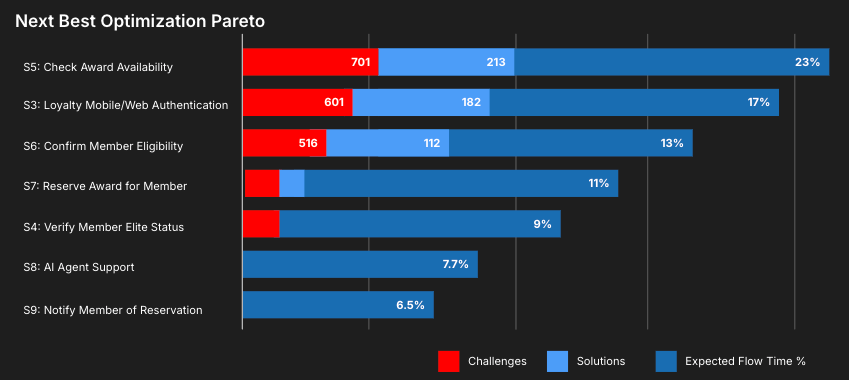
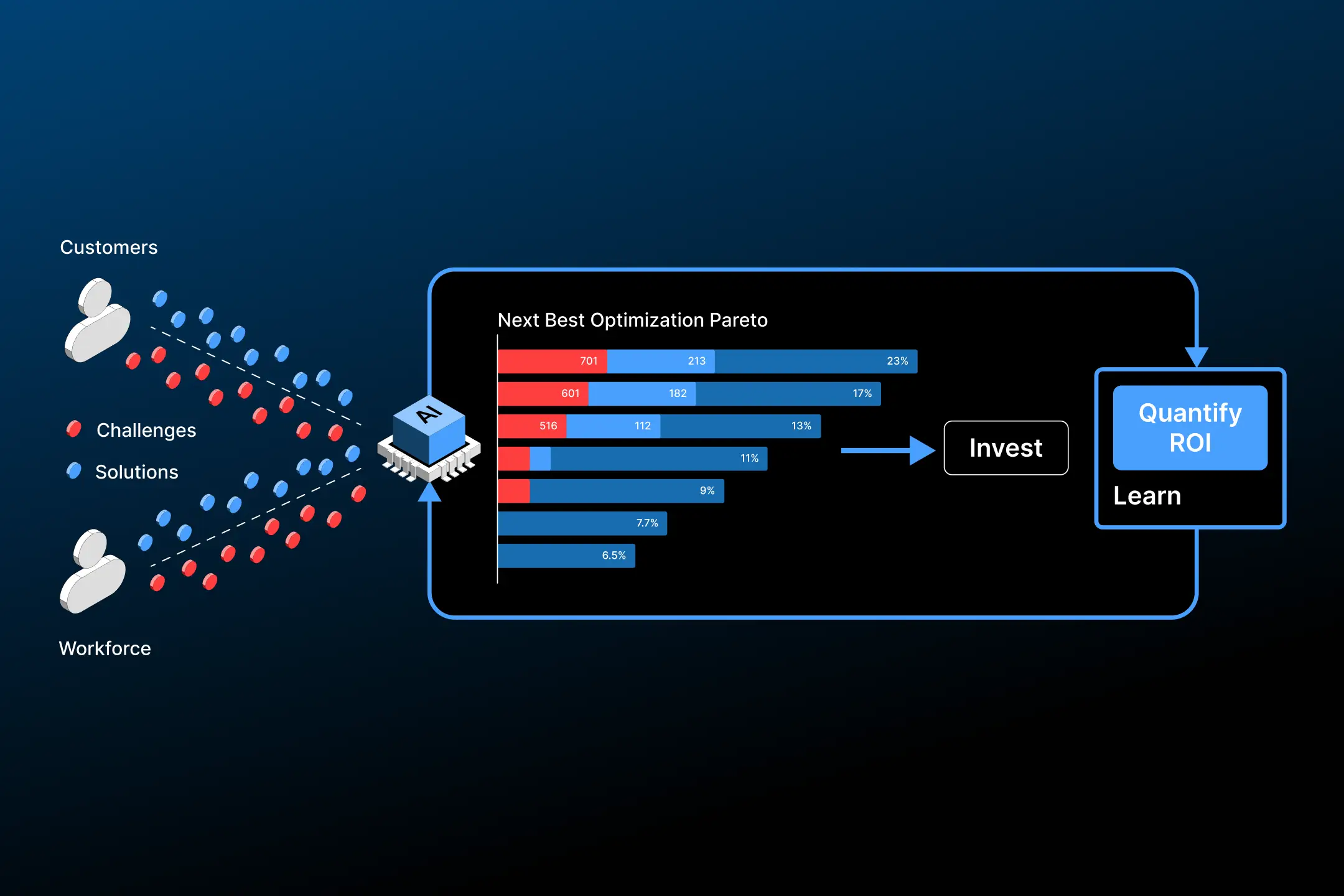
Next Best Optimization Pareto:
In the graph above, challenges and solution ideas from customers, the workforce, and other data feeds are synthesized and mapped over the highest constraints in the process or workflow model.
Using the “Moneyball” approach, small, targeted investments at the intersection of challenges, top constraints, and solution opportunities yield outsized ROI and customer engagement.
This applies across contexts: converting customer and product signals into better solutions, improving taxpayer services, and elevating patient experience and outcomes in healthcare. It also captures frontline workforce signal to continuously optimize daily operations.
A Force Multiplier: Goodwill and Engagement Reinforcement
Switching costs for the customer are lower than ever. Global competition and supply-side AI development will make it increasingly difficult for established companies to differentiate and retain customers. In the worst-case scenario, companies rushing into agentic development may actually fragment value further, creating high volumes of product slop that aren't what customers really need or want.
PwC’s 2024 Global Consumer Insights found that customers are switching brands at nearly 2X the rate of just a decade ago, with loyalty hitting record lows as consumers prioritize seamless, personalized experiences.
Engagement Reinforcement is a defensive moat. Linking innovation to the customer segment that drove it -creates a brand engagement positive feedback loop.
Recognition Reward: customer pull makes the product better.
Human Connection: taps into the brain science of intrinsic motivation: feeling "seen" creates a deeper emotional brand connection.
Engagement Loyalty Engine: When the alpha or beta is released, you can enage with the customers who helped define the solution to test. This feedback mechanism, creates a new class of hyper-engaged brand influencers.
“In major consumer businesses, loyalty members can represent a majority of revenue and materially lift margins. Boston Consulting Group cites up to 60% of revenue from loyalty members.”
The Reinforcing Loop: Progressive Development
This approach transforms product management into an Outcome-Driven discipline. We are no longer managing backlogs; we are managing investment yeild.
Pulse: Continuous aggregation of customer signals via nVeris and internal application data and third-party enrichment (e.g., review sites, support cases, app telemetry).
Model: AI modleing determines the Next Best Optimization based on proven demand patterns.
Execute: Agentic development ships a small-batch, progressive change directly into the hands of the targeted segment.
Quantify: Real-time adoption metrics and ROI feed back into the model to refine the next hypothesis.
From Agile to Agentic Yield
The original New New Product Development Game was about keeping the development ball in play for faster innovation. The Agentic Game is about knowing exactly where the customer goalpost is before you start the play.
By shifting our focus from the supply side (volume of product) to the demand side (next best optimization for a specific customer), we unlock a level of precision that eliminates the "guesswork" of traditional PM.
This is the future of the craft: a model-optimized, signal-rich environment where product development is always an investment with house money, never a gamble.
Get Started
Contact us to run your nVeris Assessment + Model Accelerator to begin Next Best Optimization in your very first session.

Chief Product Officer & Co-Founder